

According to the World Health Organization (WHO), back pain is the world's leading cause of disability. In the Netherlands, approximately 44% of the population experiences back complaints every year, according to the National Institute for Public Health and the Environment (RIVM). The societal burden is enormous: healthcare costs, productivity loss and absenteeism collectively run into the billions annually. Yet in the vast majority of cases back pain is not dangerous and resolves on its own, provided you do the right things.
1.How does back pain develop?
The spine consists of 33 vertebrae, 23 intervertebral discs, countless muscles, tendons and ligaments, and the spinal cord with its branches. That complexity makes the musculoskeletal system powerful, but also vulnerable to overload. In the vast majority of cases, approximately 85 to 95 per cent, back pain has a so-called non-specific cause: there is no identifiable structural abnormality on a scan or X-ray. The pain is then the result of a combination of muscle tension, joint loading, posture and psychosocial factors such as stress and fatigue.

2.Acute or chronic: an important distinction
Back pain is classified as acute (less than six weeks), sub-acute (six to twelve weeks) or chronic (more than twelve weeks). This distinction is clinically relevant because the approach and prognosis differ fundamentally. Acute back pain has a favourable prognosis in most cases: 90% of patients are free of complaints within six weeks, even without treatment. But in a significant proportion of people, an estimated 10 to 15 per cent, pain develops into a chronic problem.
3.What can you do yourself?
With acute back pain the advice is almost always the same: stay active. Adapt your activities and avoid movements that strongly worsen the pain, but do not stop completely. Walking, light household tasks and maintaining your normal daily routine are better than bed rest. Paracetamol can provide short-term relief for severe pain as a painkiller, but addressing the underlying cause remains the priority.

4.The role of movement and posture
Prolonged sitting has been called the 'new smoking' in popular discourse, and not without reason. With prolonged static loading, pressure on the intervertebral discs increases, the deep stabilising muscles of the back weaken, and the hip flexors become unnecessarily tensioned. This creates an imbalance that promotes back pain over time. Regularly changing position, alternating with standing desk moments and taking short movement breaks every 30 to 45 minutes is more effective than searching for the perfect sitting posture.
5.When is physiotherapy necessary?
Physiotherapy is recommended when your complaints do not substantially improve after four to six weeks, when you experience radiating pain in the leg, when weakness or sensory disturbances occur, or when pain seriously disturbs your sleep. With recurrent back complaints that recur several times a year, professional guidance is also advisable. The pattern then points to an underlying factor that has not yet been addressed.
With the following red flags you should always consult a doctor immediately: loss of bladder or bowel control, severe radiating pain in both legs simultaneously, fever combined with back pain, or pain that worsens at night and does not respond to rest. These can be indicators of a serious condition requiring medical intervention.
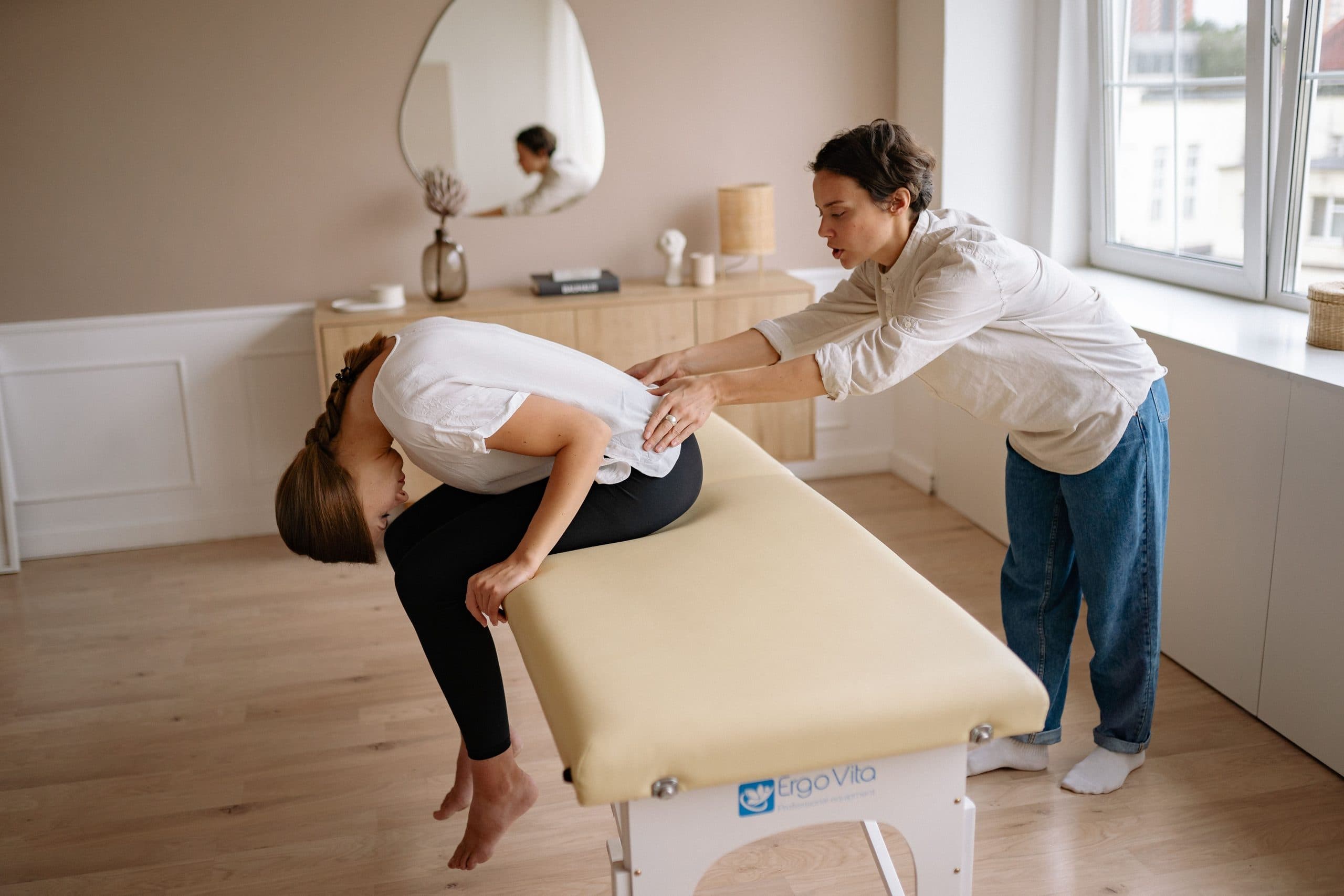
6.Treatment at Fysiotherapie Wennekers
At Fysiotherapie Wennekers we use an integrated approach to back complaints. We always begin with an extensive intake in which we not only look at the physical side but also ask about your working posture, sleep pattern, stress level and exercise habits. Only when we fully understand the context do we draw up a treatment plan that truly fits you.
Depending on the diagnosis we can use manual therapy, dry needling, shockwave therapy or diagnostic ultrasound. Exercise therapy aimed at strengthening the core musculature always forms an essential part of the trajectory.
Do you have back complaints and want to know what we can do for you? Book an appointment directly or contact us for more information.

Menno Wennekers
Physiotherapist
22 May 2025 · 8 min read